What we think of as the present is really just the leading edge of the past, pushing us relentlessly toward a future that never really arrives. So if you’re looking for an extra dash of depression in your life, you can adopt my belief that all we have is the past.
But that’s not so bad — the past contains anything that ever happened and everyone who ever lived, including all your friends and that great lunch you had at that place that time. So it can’t be boring. But there are rules about what we can do with the past. Despite all the time-travel movies, we can’t actually go there or live there, we can only look — back.
And we can’t not look. Those who can’t look back are amnesiacs. Those who won’t look back are fools.
Passenger-side rear-view mirrors warn us that objects are closer than they appear. The backward glance is dangerous but also necessary. Looking in the mirror too long will crash us into something sooner or later, so for everyday life we need the backward glance more than the longer backward gaze. But now and then, hopefully not behind the wheel, we need to take a bit more time looking at the past, trying to figure out what we need from it, what it did for us and to us, and how we can use it to improve our lives.
I should define the terms I’ve arbitrarily created for this site. The Backward is all of the past, and all the ways we relate to the past. The Near Backward is the part that has us in it — it’s in our personal memory bank. I have my own Near Backward and so do you. But they overlap (even in our fragmented times I hope we have some things in common). But stretching out for thousands of years beyond that is the Far Backward. It’s harder to see the connections, the way that lost Backward world has created our world. But the connections are there.
If I go on beyond the Far Backward and hit dinosaurs, that’s the Too Far Backward. As much as I love dinosaurs, maybe I’ll try to avoid that.
Yes, I could use the prosaic word “history” instead of The Backward. But after a quarter-century of teaching classes with the word history in the title, I feel the need to shake things up and maybe find some new perspectives on how our world got this way. I don’t have answers yet. This site is me feeling my way toward some new questions. You’re welcome to join me.
It seems pretty common to assume that we got terrible just recently — that there was a time when life was simpler and people were more authentic, and that the degeneration has come within our own lifetime. Our individual Near Backward begins with us as innocent babes, and we tend to assume that’s what society was like as well. But when we look around us, we see George Santos, the human chameleon of grift, as an avatar of our age. And we see constellations of people who are profiting off of inconceivable fame — why are we supposed to care what Kardashians are up to, anyway?
All this is new, right? Well, nope.
One of my favorite books when I started doing this historian business — remember, this was way back in the Eighties — was The Image: A Guide to Pseudo-Events in America by Daniel J. Boorstin. Originally published in 1961, it was a curmudgeonly view of the decline of American culture powered by the new medium of television. Real events, he believed, had been replaced by manufactured events and heroes by celebrities (anything sound familiar here?). The book’s most lasting contribution has been its definition of a celebrity: “a person who is known for his well-knownness.”
Well that’s still in my Near Backward, even if it isn’t in yours. But you can see the same kind of despair among cultural observers in the 1920s and 1930s. There was always a time when authenticity and good sense reigned — but not this time.
How about going back to the Enlightenment — the Age of Reason? At least that has to be, um, reasonable, right?
So this is a story about the Age of Reason. London was one of the centers of Enlightenment thinking, and one of the intellectual centers of London was the Royal Society, a club for scientists and philosophers. Sir Isaac Newton was one of the leading lights of the Society, so this was the heavy hitters of the day.
At one meeting of the Royal Society in 1704, the first successful vacuum pump was demonstrated — a genuine boon for many kinds of experiments. An opossum penis was dissected. And a young man who called himself George Psalmanazar gave a lecture describing his homeland — the faraway and little-known (to Londoners anyway) island of Formosa.
Today we know Formosa as Taiwan and we know more about it (even given the deplorable state of geographical education). Back then the island was the site of colonial ventures by Portugal, Spain, and Japan. Han Chinese had begun to move from the mainland as well, joining the indigenous population. The name Formosa had been invented by the Portuguese; it means “beautiful.” (For those of you to whom the phrase “deplorable state of geographical education” applies, we’re talking about an island off the coast of China.)
Like all the other lands being feverishly colonized at the time, Formosa for Europeans was the object of insatiable curiosity and abysmal ignorance. The English and French, for example, had never seen a Formosan or heard any description of the island. Hence the Society’s invitation to George Salmanazar.
It should be said right off that George Salmanazar was not, as he claimed, a native of Formosa. He seems to have been French. A master of languages, he passed himself off as Irish in his travels through France, Italy and Germany. When too many actual Irishmen challenged his identity, he switched to claiming he was Japanese, and then Formosan. When Jesuits who had been missionaries in Formosa said he was a fraud, he “converted” to Anglicanism and said the Jesuits were liars. That got him a ticket to England, where they hated Jesuits as much as he did.
His inventiveness was amazing — he created a spoken and written Formosan language, and national customs, dress and religion. The capital of his Formosa was Xternetsa. If people wondered about his blond hair and pale skin, it was because the upper classes of Formosa live underground. They drink green tea for breakfast, then cut the head off a viper and suck its blood.
Psalmanazar was challenged by some of the Fellows of the Society — notably Edmond Halley, the comet guy — but came out mostly unscathed and his fame continued to grow for a couple of years. He published a book which included the Formosan alphabet and the Lord’s Prayer in the language, plus descriptions and images of architecture and modes of dress — pastiches of various parts of the world. You can read it at https://archive.org/details/historicalgeogr00psal/page/194/mode/2up
It wasn’t long before the Enlightenment’s expanding knowledge of the world forced Psalmanazar to confess. He went off into more obscure occupations and the Formosa craze faded. But for a while, he was a true Age of Reason celebrity. He was known for his well-knownness — and the more outrageous his claims, the more famous he was. Maybe the difference between that time and our own is that, when he was proved to be a liar, people lost interest in him. Score one for the Far Backward, I guess.
When I started, my students were mostly from the borderland between Generation X and the Millennials. Now I’m teaching Gen Z, and the Alphas are coming. I’m not really one for labels and categories — and I see more variations within generations than I do between generations. But there seems to be a cottage industry built around pitting generations against each other. For the record, I think Gen Z is all right.
Taking the long view — the Far Backward — there’s nothing new about generational conflict and back-biting. Aristotle said the the young people of his own time “are high-minded because they have not yet been humbled by life, nor have they experienced the force of circumstances. . . . They think they know everything, and are always quite sure about it.” I suspect that those young people thought Aristotle was a crabby old man.
But this business of naming generations seems to be a relatively new thing. I think my generation was the first to get a name — the Baby Boomers of the post-WWII years. (Yeah sorry I’m a Boomer.) Gen X got a name and a label in 1987. My parents generation, the “Greatest,” didn’t get the label until Tom Brokaw published a fawning book in 1998. And having one cohort called “The Greatest Generation” doesn’t seem likely to encourage intergenerational peace. I’ll probably have more to say about generational theory in another post.
What I actually came here for was to do what I’ve been doing these days with my classes — addressing my Gen Z’ers as a Boomer profoundly disappointed with my own generation. When I was my students’ age, we were the generation that would save the world and usher in the Age of Aquarius. We were not going to be rigid or materialistic like our parents. We were going to protect the environment, and end poverty and racism. (No, really!) And then I watched my generation move out into the world and become what we had hated. There aren’t many people my age that I care to hang out with any more.
Maybe that’s the tragedy of every generation. Your vocabulary word for today is an uncommon one: enantiodromia — the gradual turning of everything into its opposite. It’s a word out of Jungian psychology. You should look it up, see if it doesn’t explain, well, everything. Not just about generations, but about what goes on in our heads.
And so my generation of idealists created the cynical and cruel world that Gen Z must inherit and try to redeem. The good news is that I see so much promise in my Gen Z’ers. Listening in to the discussions where you have tried to make sense of how we’ve gotten here, I almost think you have a chance to turn it around — once the olds let loose of the reins of power.
I keep hearing our current whatever-this-is referred to as the Second Gilded Age. It certainly checks all the Gilded Age boxes —
Gaudy exterior over a tawdry reality? Check.
Worship of extremely wealthy people with extremely bad taste? Check.
Widening gap between the wealthiest few and everybody else? Check.
Open corruption, both fiscal and political? Check.
Blaming the poor and shrinking the middle class? Check.
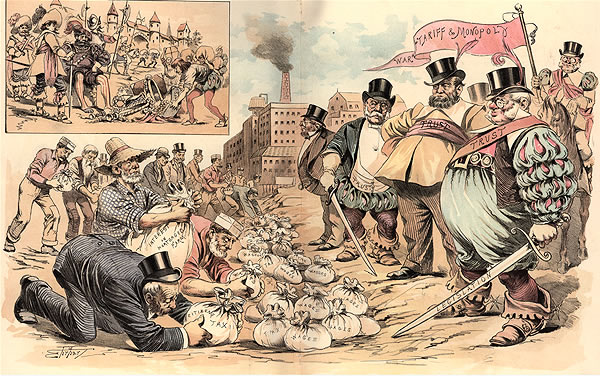
Our index era, Gilded Age Prime, is of course the late 19th century, when the new industrial era was creating a few fortunes on a scale not seen before. Mark Twain and Charles Dudley Warner coined the phrase, a cynical label for the cynical time they lived in. Large-scale industrial capitalism had replaced the artisanal capitalism of the early Republic, businesses were consolidating, and scratching the surface of polite society revealed the law of the jungle.
In 2025, the president may claim we’re entering a new American Golden Age, but no, it’s definitely gilded. A look at the redecoration of the Oval Office will confirm that. (See “bad taste,” above.) The hero-industrialists of the 1880s have been replaced by the tech-bro billionaires. Trump rhapsodizes about the protective tariffs of the 1880s, and seeks to return to that era’s lack of regulation. The corruption — well, I rest my case.
But is this the Second Gilded Age we’re in? Within my own Near Backward, this all seems very familiar. I’m sorry to deploy the stock phrase, but I’m Old Enough to Remember the Reagan era, when many of these things or their analogs were going on. We even called it the Second Gilded Age. So that pushes our Gilded Age back to third place.
In some ways the Reagan Second Gilded Age never ended. Even when Democrats regained the White House, Bill Clinton and Barack Obama internalized many of the “lessons” of the Eighties, assuming that the electorate had turned against more progressive policies. The gap between the richest and the rest has mostly continued to grow, and the luster of tech industries had a series of bubbles and bursts. The erosion of the middle class and the grinding-down of the poor has mostly lasted. A recent anomaly occurred in the first half of the Biden presidency, with policies that could have reversed those trends if they had been allowed to continue. Trump’s second term has quickly snuffed those hopes out.
But heading on into the Far Backward, there’s another contender, I think. The Progressive Era, which had tried to roll back the excesses of the Gilded Age, came to a ragged end with America’s World War One experience; and by the 1920 election, Warren Harding was able to sell the voters on a “return to normalcy” which we know familiarly as the Roaring Twenties. Many of the Progressive business regulations were rolled back or ignored, and the “Captains of Industry” like Henry Ford and Harvey Firestone were national heroes.
I haven’t seen any evidence of people in the 1920s referring to their own time as a Second Gilded Age — but maybe it’s time to bestow that title retroactively. We all know how that boom of the Twenties turned out — Gilded Ages tend to sow the seeds of their own destruction.
So that puts our current Gilded Age in the number four position. None of these Gilded Ages stand up very well to the scrutiny of history, and I have no doubt that the time will come when this one gets its day of judgment.
But have I left any Gilded Ages out? Should we go farther Backward, before the phrase existed? Or was America’s relationship with wealth different before the Civil War?
One response to “How many Gilded Ages does this make?”
Anonymous
I’ve been trying to find out when America was great and what time this guy wants to go back to. He’s just selling something he knows nothing about. IMHO



 The Far Backward
Leave a comment